










【NEW】 Thermal Desorption Hydrogen Analyzer ESCO-TDS600 IR H2
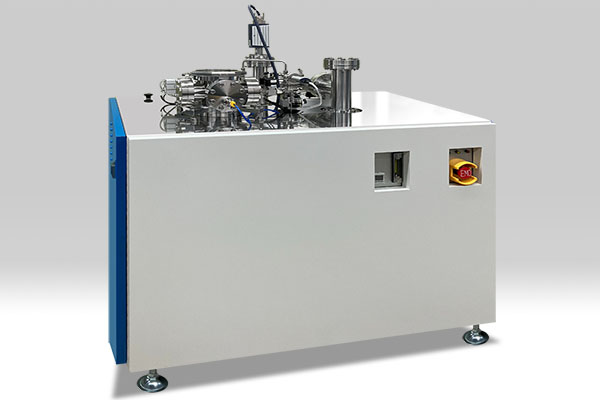 Thermal Desorption Hydrogen Analyzer ESCO-TDS600 IR H2
Product Overview: ESCO-TDS600 IR H2
The ESCO-TDS600 IR H2 is a high-performance Thermal Desorption Hydrogen Spectrometer equipped with an ultra-high sensitivity mass spectrometer.
It is meticulously engineered to precisely detect and quantify trace levels of hydrogen—down to the single-digit ppb (parts-per-billion) range—released from metallic materials and advanced plating films.
While utilizing a sophisticated, vacuum-based mass spectrometry method, the system breaks conventional complexity by achieving a revolutionary "one-touch" workflow.
User operation is as simple as closing the lid and pressing the start button, delivering an unmatched ease of use that even beginners can master seamlessly on the factory floor.
From cutting-edge materials research and development to rigorous on-site quality control, this system transforms the invisible threat of "delayed fracture" (hydrogen embrittlement) into definitive,
high-fidelity quantitative data—powering and securing the future of next-generation manufacturing.

 Image of an automotive frame
Diffusible Hydrogen at Single-Digit ppb Levels: A Critical Threat to High-Strength Materials
The sudden and catastrophic failure (delayed fracture) of ultra-high-strength steels and advanced alloys is primarily driven by "diffusible hydrogen"—hydrogen atoms that remain highly mobile within the metal matrix.
Even at miniscule concentrations of just a few ppb (parts-per-billion), its mere presence poses a severe threat to long-term material reliability.
For standard safety assessments, international test standards such as ISO 3690 and AWS A4.3 are widely utilized across industries to quantify hydrogen content. However, the degradation mechanisms triggered by hydrogen are exceptionally complex.
As modern materials achieve unprecedented strength and operational environments become increasingly severe, cutting-edge R&D laboratories and manufacturing facilities are encountering cases
where baseline compliance with these standard methods falls short of fully explaining the subtle, microscopic delayed fracture behaviors that manifest during actual tensile testing.
To guarantee a higher dimension of component safety, industries now require the ability to precisely and immediately discern both diffusible hydrogen (the direct trigger of delayed fracture)
and more strongly trapped hydrogen states right on the production or testing floor at the ppb level.
Our system seamlessly and powerfully complements existing standard-compliant testing frameworks, delivering deeper, actionable insights that empower the next evolution of advanced manufacturing.
The Dilemma of Hydrogen Analyzer Selection
Traditionally, choosing a hydrogen analyzer involved a significant trade-off: while "mass spectrometry (MS) systems" offer exceptional sensitivity for detecting trace-level hydrogen, they are considerably more expensive than "gas chromatography (GC) systems.
" Conversely, while GC systems are relatively affordable, they lack the necessary sensitivity required to precisely measure subtle, single-digit ppb-level hydrogen behaviors.
The ESCO-TDS600 IR H2 is a groundbreaking instrument designed to eliminate this long-standing dilemma.
While fully retaining the high sensitivity and rigorous quantitative capability inherent to mass spectrometry, its proprietary engineering achieves outstanding,
user-friendly operability and a low initial investment cost—completely shattering the conventional barriers associated with ultra-high vacuum (UHV) systems.
Comparison Table: ESCO-TDS600 IR H2 vs. Gas Chromatography
| Criteria | ESCO-TDS600 IR H2 (ESCO, Ltd.) | Gas Chromatography (Atmospheric Type) |
|---|---|---|
| Analysis Method | Ultra-High Vacuum (UHV) & Mass Spectrometry | Atmospheric Pressure & Gas Chromatography |
| Sensitivity & Quantitativeness | [Excellent] High (No secondary reactions / ppb-level) |
[Fair / Concerns] Potential Issues (Risk of secondary reactions) |
| Ease of Operation | [Excellent] Simple (Just place the sample and press start) |
[Excellent] Simple (No vacuum chamber required) |
| Data Acquisition Speed | [Excellent] High-speed (Once per second) |
[Fair] Slow (Approx. once every few minutes) |
| Positioning | Combines the high sensitivity and precision of mass spectrometry with the ease of gas chromatography. | Affordable and simple option. |
A Practical Model Bridging the Lab and the Production Floor for Rapid
Pass/Fail Screening
Compared to the high-end ESCO-TDS1200II IR, the ESCO-TDS600 IR H2 is a practical model that masterfully balances on-site simplicity with laboratory-grade performance.
The system architecture is precisely engineered to meet the critical demands at the forefront of quality control: enabling operators to perform hassle-free, on-site pass/fail determinations through the rough comparative analysis of diffusible hydrogen content.
[ Four Key Features and Core Technologies of the ESCO-TDS600 IR H2 ]
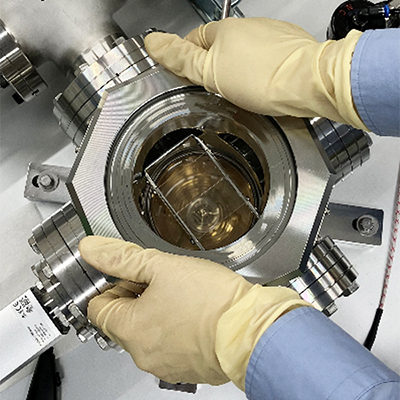
1. Simple Measurement Operation Accessible
to Beginners
Despite operating under a high-vacuum environment, this system eliminates the need for complex vacuum sample transfer mechanisms.
Users can initiate a measurement simply by placing the sample directly on the quartz stage inside the heating chamber, closing the lid, and pressing the start button.
This streamlined workflow ensures stable, consistent operation regardless of the operator's skill or experience level.
2. Signal Profile Retention and Precise Analysis Driven by Unrivaled "High-Speed Detection“
This system boasts a remarkable detection speed of once per second. Compared to atmospheric-pressure gas chromatography (GC) systems, which typically measure only once every few minutes, this represents a staggering 300-fold increase in speed.
Fundamentally, GC systems struggle to accelerate heating rates because the process of separating hydrogen gas through a column requires a significant amount of time. Consequently, they suffer from a structural limitation that restricts the standard heating rate to around 100°C/h.
In contrast, since this instrument utilizes a mass spectrometer with a sampling frequency of approximately once per second, it faces absolutely no heating rate restrictions imposed by detection intervals.
The primary advantage of this high-frequency sampling is that even under rapid heating conditions, it captures the intricate, native profile of the thermal desorption signal, ensuring that the "true peak temperature (Tp)" is never missed.
Table: Comparison of Temperature Detection Resolution by Measurement Method
| Heating Rate | Temperature Detection Interval (Resolution) | |
|---|---|---|
| ESCO-TDS600 IR H2 (Once per second) |
Gas Chromatography (GC) System (Once every 5 minutes) |
|
| 100°C/h (1.67°C/min) | 0.028°C | 8.3°C |
| 300°C/h (5°C/min) | 0.083°C |
25.0°C |
| 600°C/h (10°C/min) | 0.167°C |
50.0°C |
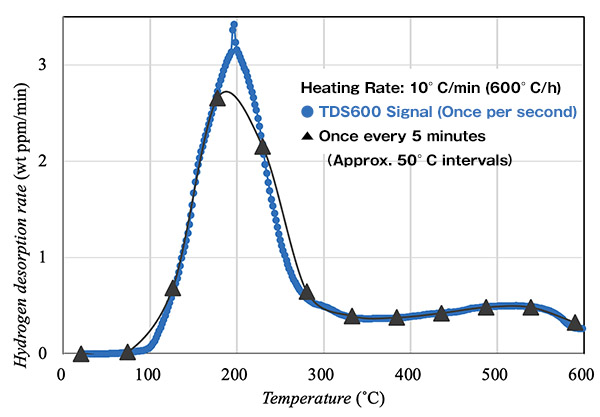 Figure 1
Figure 1: [Comparison] Simulation of a Missed Hydrogen Peak Due to Differences in Detection Frequency
As illustrated by the graph in Figure 1, a low detection frequency (once every 5 minutes, which corresponds to temperature intervals of approximately 50°C in this simulation) fails to capture the subtle peak located around 196°C.
In contrast, the TDS600 ensures that the hydrogen desorption peak is accurately and reliably captured.
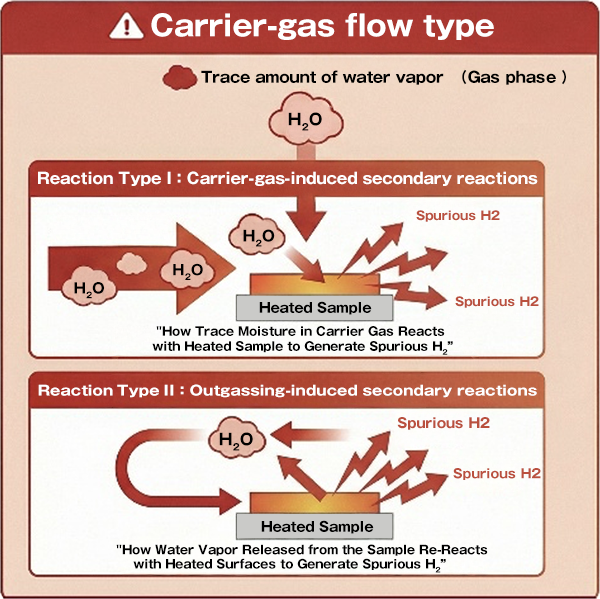 Atmospheric pressure type (gas flow method)
3. Elimination of Secondary Reactions Through Ultra-High Vacuum (UHV) Measurement
In conventional carrier-gas flow systems, there is an inherent risk that the carrier gas or other desorbed gases may react with the specimen surface, potentially generating "non-sample-derived hydrogen"—hydrogen that does not originate from the material itself.
Because this instrument performs measurements under a strict ultra-high vacuum (UHV) environment, it fundamentally eliminates these secondary reactions, ensuring that only the true, unaltered amount of hydrogen desorption is accurately and exclusively captured.
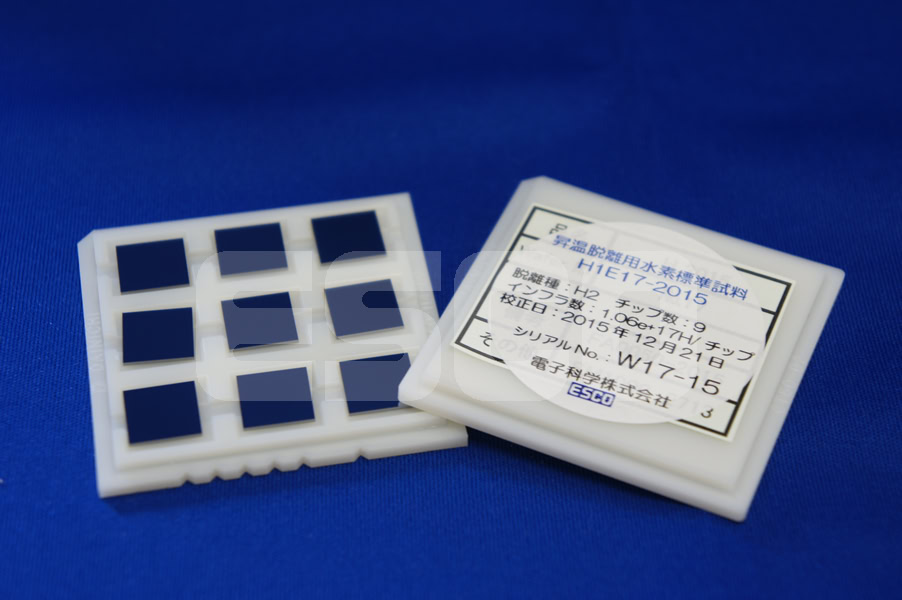 Hydrogen Standard Sample
4. Highly Reliable "Hydrogen Sensitivity Calibration“
The mass spectrometer of this system is calibrated using hydrogen reference standards that are precisely calibrated against standard leaks recommended by the National Institute of Standards and Technology (NIST).
This robust calibration framework ensures that all quantitative data obtained by the instrument maintains the highest level of international traceability and rigorous accuracy.
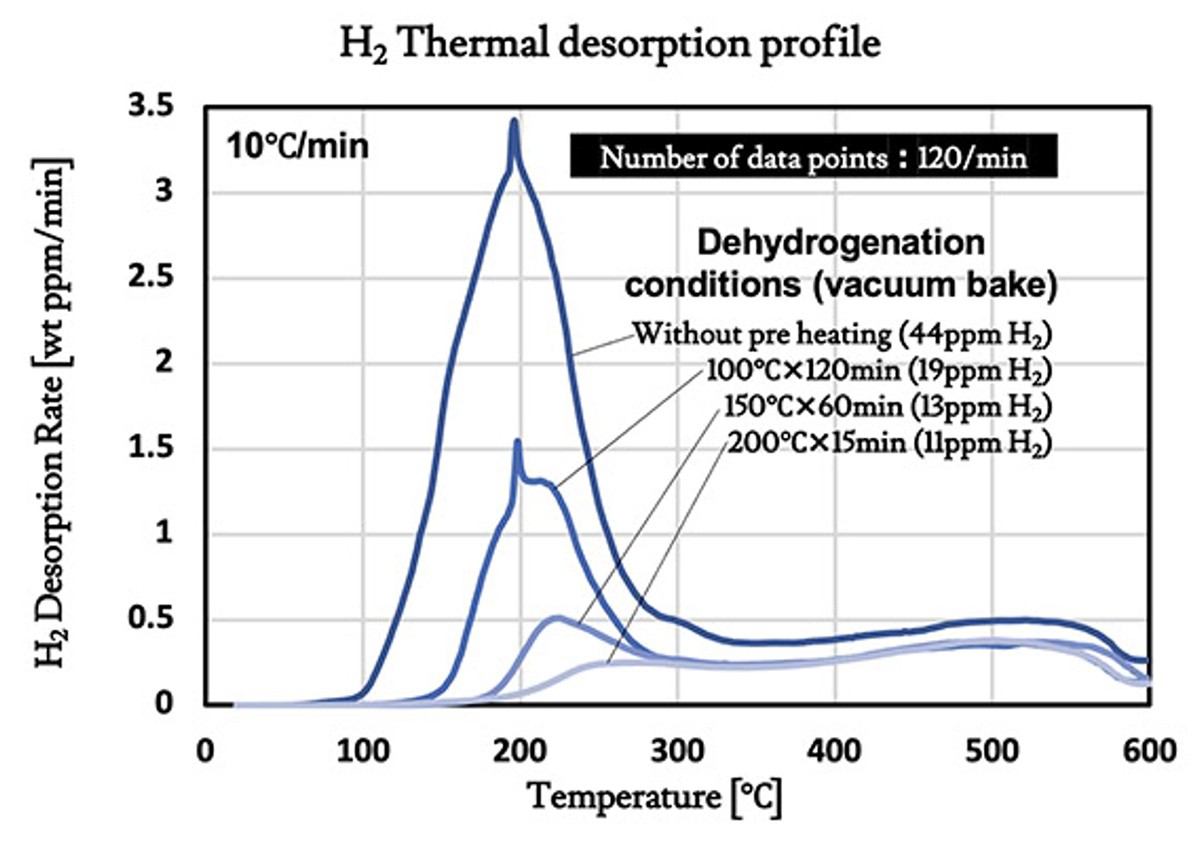 Fig. 2
[ Application Example: ESCO-TDS600 IR H2 ]
■ Analysis of Hydrogen in Electroless Nickel Plating (5 μm) and Evaluation of Dehydrogenation Treatment
This application example details the measurement of trace hydrogen desorption behavior from a 5-μm-thick electroless nickel plating layer. It compares the differences in residual hydrogen content based on various dehydrogenation baking conditions.
Figure 2: Hydrogen Thermal Desorption Profiles of Electroless Nickel Plating (Four Conditions: As-Plated, 100°C, 150°C, and 200°C)
[ Measurement Conditions ]
・Heating Rate: 10°C/min (600°C/h)
・Detection Speed: Once every 0.5 seconds (120 data points/min)
The graph compares the hydrogen desorption profiles under four distinct processing conditions.
The values indicated in parentheses represent the total amount of desorbed hydrogen measured during analysis—in other words, the "amount of residual hydrogen remaining in the nickel plating film after each specific dehydrogenation treatment."
Experimental Conditions & Discussion
① As-Plated / Untreated (Residual hydrogen: 44 ppm)
② Heated in vacuum: 100°C for 120 minutes (Residual hydrogen: 19 ppm)
③ Heated in vacuum: 150°C for 60 minutes (Residual hydrogen: 13 ppm)
④ Heated in vacuum: 200°C for 15 minutes (Residual hydrogen: 11 ppm)
These results clearly demonstrate that higher processing temperatures yield a significantly more effective dehydrogenation outcome.
Even with shorter heating durations, a greater volume of hydrogen is successfully desorbed, leaving a substantially lower amount of residual hydrogen trapped within the plating film.
When a rapid heating rate of 600°C/h is utilized, conventional gas chromatography (GC) systems with low detection frequencies (e.g., once every 5 minutes, corresponding to 50°C intervals) struggle to capture the precise apex of sharp desorption peaks.
In this experiment, however, our unrivaled high-speed measurement of once every 0.5 seconds ensures that the steep, sharp hydrogen desorption peaks originating from the ultra-thin 5-μm film are captured flawlessly without missing a single data point.
This system delivers definitive, high-fidelity data that directly empowers on-site quality control, allowing engineering teams to confidently determine and optimize their manufacturing processes.
[Technical Specifications: ESCO-TDS600 IR H2 ]
General Specifications
・Maximum Sample Size: 30 × 30 × 30 mm
・Hydrogen (H2) Desorption Sensitivity: ng/g (ppb)
Analysis Chamber
・H2 Detector: Mass Spectrometer (2~4 Da)
・Pressure Gauge: BA-Pirani Combination Gauge (Measurement Range: 5×10⁻⁸~1×10⁵ Pa)
・Temperature Sensor: Sample Stage Thermocouple (Type K)
・Chamber Specifications: Capacity: 10 L, Ultimate Vacuum: ≦1×10⁻⁶ Pa
Heating Control
・Temperature Control Range: Room Temperature (RT) to 600°C
・Heating Rate Control Range: 0.5°C/min to 180°C/min
・Number of Heating Steps: Max. 100 steps
・Heating Source: 1 kW Halogen Lamp
Software Suite
・Measurement Software
・Real-Time Monitor: Hydrogen signal intensity (m/z 2~4), measurement time, pressure, and temperature
・Setup Functions: Simple configuration of mass spectrometer parameters, heating profile programming
・Automated Start/Stop Function: Automated measurement control triggered
by MS signal intensity, elapsed time, pressure, or temperature
・Support Function: Sensitivity calibration wizard / assistance function
Data Processing Software
・Graph Display: Temperature plots, pressure plots, TDS spectra, and mass spectra
・Background Correction: Minimum value, exponential, spline, and file-based background subtraction
・Data Export: CSV format output (m/z2,3,4 signal intensity, time, pressure, temperature, temperature control output,
and desorption rate)
